
On this pageWhat Is Melanotan 2?
Melanotan 2, written formally as Melanotan II and often shortened to MT2 or MT-II, is a synthetic analog of alpha-melanocyte-stimulating hormone (α-MSH). It was designed as a more stable, more potent version of the natural hormone and has been used for decades as a laboratory tool for studying the melanocortin receptor system. This overview covers its structure, receptor activity and the main areas of published research.
What Is Melanotan 2?
Melanotan 2 is a cyclic heptapeptide, a ring-shaped molecule built from seven amino acids.
- Sequence: Ac-Nle-cyclo[Asp-His-D-Phe-Arg-Trp-Lys]-NH2
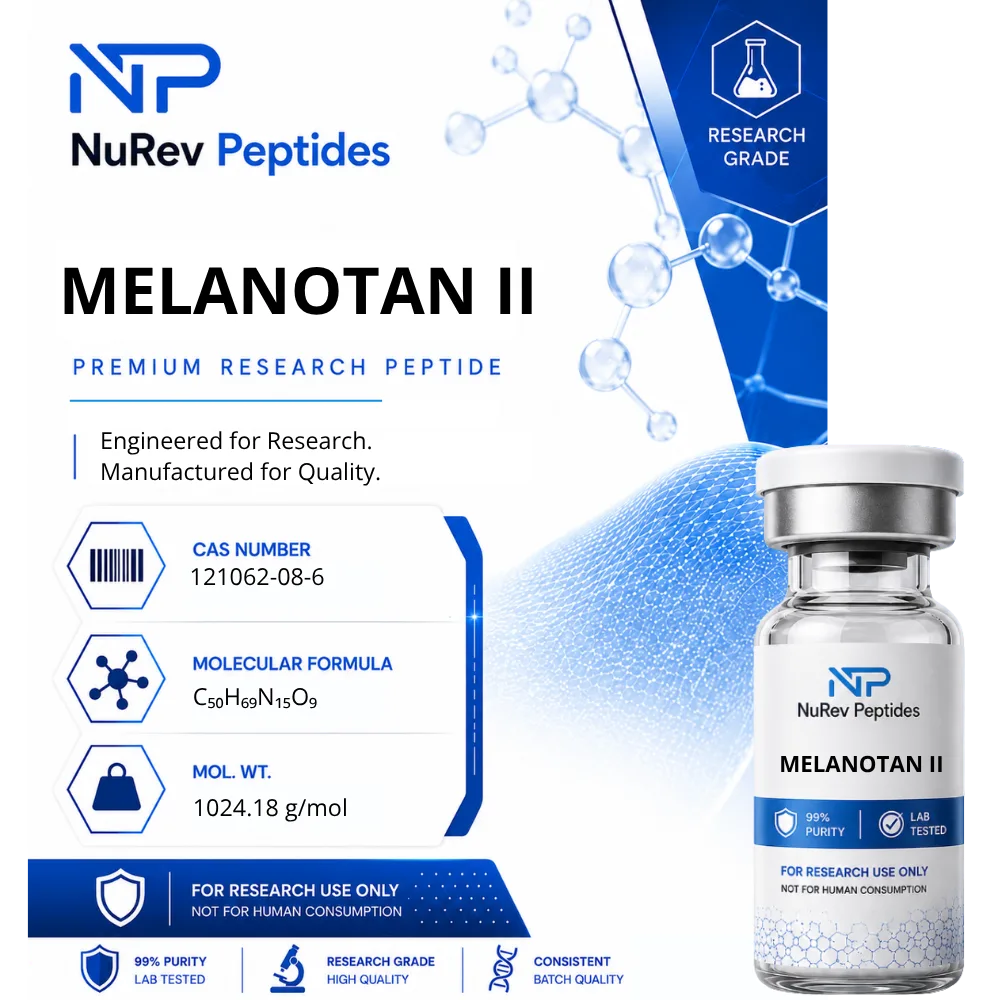
- Molecular formula: C50H69N15O9
- Molecular weight: approximately 1,024.2 g/mol
- Class: non-selective melanocortin receptor agonist
- Form supplied for research: lyophilized powder
Development Background
Melanotan 2 was developed in the 1980s by researchers at the University of Arizona who were studying α-MSH. The natural hormone breaks down quickly, so the team created shortened analogs with a lactam bridge, a chemical link that closes the peptide into a ring. The cyclic structure made the molecule more resistant to enzymatic breakdown and increased its potency at melanocortin receptors.
How Melanotan 2 Works: Melanocortin Receptors
Melanotan II binds to several members of the melanocortin receptor family. Because it is not selective for one receptor, it produces a broad range of effects in experimental models, which is both its value and its limitation as a research tool.
- MC1R: found on melanocytes; involved in melanin synthesis and pigmentation
- MC3R: involved in energy homeostasis
- MC4R: expressed in the central nervous system; involved in feeding behavior, energy balance and sexual function pathways
- MC5R: associated with exocrine gland function
Areas of Melanotan 2 Research
Pigmentation and MC1R signaling
Activation of MC1R shifts melanocytes toward producing eumelanin, the darker form of melanin. Melanotan II has been used to study this pathway and how melanocortin signaling regulates pigmentation in cell and animal models.
Energy balance and feeding behavior
In rodent studies, central melanocortin agonists including Melanotan II have been used to investigate how MC3R and MC4R influence food intake and energy expenditure. This work has contributed to the broader understanding of the melanocortin system in metabolic regulation.
Sexual function research and the origin of PT-141
During early studies, investigators observed effects on sexual arousal that were traced to central melanocortin receptors. That observation led to the development of bremelanotide, also called PT-141, a related compound studied specifically for this pathway. NuRev's PT-141 research overview covers that compound in more detail.
Receptor pharmacology
Because it activates several melanocortin receptors at once, Melanotan II is often used as a reference agonist when researchers characterize more selective compounds.
Key Published Melanotan 2 Studies
These papers cover the design of the compound and the research it led to:
- Potent and prolonged acting cyclic lactam analogues of alpha-melanotropin: design based on molecular dynamics (Al-Obeidi and colleagues, Journal of Medicinal Chemistry, 1989). The medicinal chemistry paper describing the cyclic lactam analogs of α-MSH from which Melanotan 2 comes.
- Role of melanocortinergic neurons in feeding and the agouti obesity syndrome (Fan and colleagues, Nature, 1997). A widely cited rodent study that used MTII as a melanocortin agonist to examine feeding behavior.
- Melanocortin peptide therapeutics: historical milestones, clinical studies and commercialization (Hadley and Dorr, Peptides, 2006). A review by two of the original investigators that traces the history of the melanotropic peptides, including Melanotan I, Melanotan 2 and bremelanotide.
Melanotan 2 vs. Melanotan I vs. PT-141
- Melanotan I (afamelanotide): a linear α-MSH analog with greater selectivity for MC1R
- Melanotan II: a cyclic, non-selective analog active at MC1R, MC3R, MC4R and MC5R
- PT-141 (bremelanotide): a compound derived from Melanotan II research, studied mainly for MC4R-related pathways
What to Look for in Research-Grade Melanotan II
- A batch-specific Certificate of Analysis from an identified laboratory
- Reported purity by HPLC
- Identity confirmation by mass spectrometry
- A lot number that matches the vial
- Clear research-use-only labeling
Batch documentation for Melanotan II 10mg is available in the NuRev Peptides Certificate of Analysis library.
Storage and Handling
Lyophilized peptides are generally kept sealed, dry, protected from light and stored cold according to the laboratory's standard procedures for peptide materials.
Regulatory Status and Limitations
Melanotan II is not approved by the FDA or by other major regulators for any use, and health authorities in several countries have issued public warnings about unlicensed products sold for cosmetic purposes. Its non-selective receptor activity means effects observed in one system are accompanied by effects in others. Research findings in cell and animal models do not establish safety or effectiveness in people.
Research Use Only
This article is provided for educational and informational purposes only. Products supplied by NuRev Peptides are intended strictly for laboratory research use and are not intended for human or veterinary use.
Frequently asked questions
What is Melanotan 2?
Melanotan 2, also written Melanotan II or MT2, is a synthetic cyclic analog of alpha-melanocyte-stimulating hormone. It is a non-selective melanocortin receptor agonist used in laboratory research.
Which receptors does Melanotan II act on?
Melanotan II is an agonist at the melanocortin receptors MC1R, MC3R, MC4R and MC5R.
How is Melanotan II different from PT-141?
PT-141 (bremelanotide) was developed from Melanotan II research. Melanotan II is a broad melanocortin agonist, while PT-141 is studied mainly for MC4R-related pathways.
Is Melanotan 2 approved for human use?
No. Melanotan II is not approved by the FDA for any use. Material sold by NuRev Peptides is for laboratory research use only and is not for human or veterinary use.
Does Melanotan II come with a Certificate of Analysis?
NuRev Peptides provides batch-specific Certificates of Analysis, available in the COA library and on the product page.