
On this pageWhat Is KPV?
KPV peptide is a three-amino-acid fragment of alpha-melanocyte-stimulating hormone (α-MSH) that laboratories use to study inflammatory signaling without the pigmentation effects of the full hormone. Its small size makes synthesis, handling and mechanistic interpretation more straightforward than with larger melanocortin peptides, which is a large part of its appeal as a research tool.
This overview covers what KPV is, how it relates to α-MSH, what cell and animal models have shown, how to assess research-grade material, and where the evidence stops.
What Is KPV?
KPV is a tripeptide made up of the amino acids lysine, proline and valine (Lys-Pro-Val). It is not a synthetic analog designed from scratch: it corresponds to the last three residues, positions 11 to 13, of α-MSH, a 13-amino-acid peptide hormone derived from pro-opiomelanocortin (POMC).
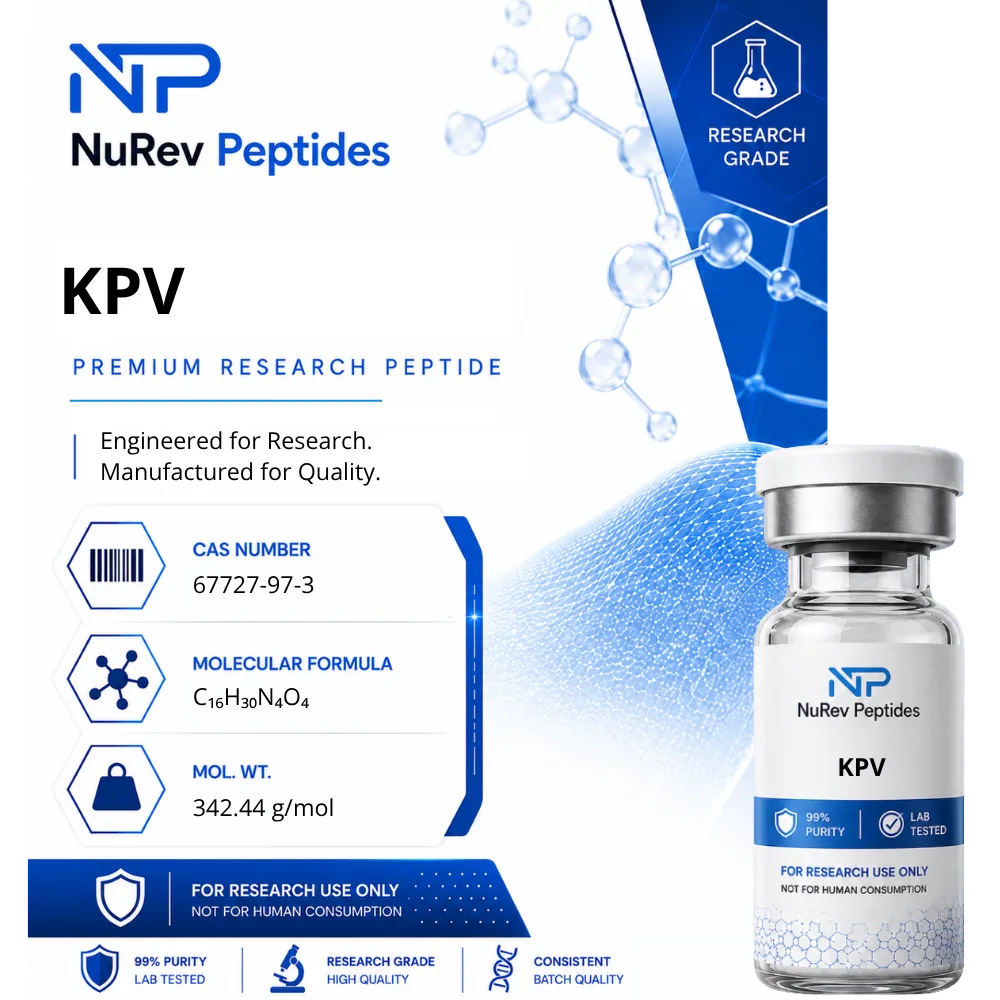
- Sequence: Lys-Pro-Val
- Origin: C-terminal fragment of α-MSH (11–13)
- Molecular formula: C16H30N4O4
- Molecular weight: approximately 342.4 g/mol
- Form supplied for research: lyophilized powder
Interest in the KPV peptide grew after researchers noticed that cutting α-MSH down to its final three residues did not eliminate its activity in inflammation assays. A molecule roughly a quarter of the length of the parent hormone appeared to keep part of its signaling effect, which raised a structure-function question: how much of the anti-inflammatory activity of α-MSH sits in that small C-terminal piece?
How KPV Relates to Alpha-MSH
α-MSH acts on the melanocortin receptor family, including MC1R and MC3R, and is known for its role in pigmentation as well as immune and inflammatory regulation. KPV shares part of its sequence but does not simply behave as a weaker version of it.
A frequently cited 2003 paper, Dissection of the anti-inflammatory effect of the core and C-terminal (KPV) alpha-melanocyte-stimulating hormone peptides, compared KPV with other melanocortin peptides in a mouse peritonitis model. KPV reduced inflammatory cell accumulation, yet it did not raise cAMP and was not blocked by a melanocortin receptor antagonist. That pattern separated it from the other peptides tested.
This is what makes KPV useful experimentally. Because it appears to act largely independently of classic melanocortin receptor signaling, it lets investigators study the inflammatory questions around α-MSH without melanogenesis as a confounding variable. The two peptides share a sequence relationship, not necessarily a receptor mechanism. The broader biochemistry of α-MSH and its tripeptides is reviewed in Brzoska and colleagues, Endocrine Reviews, 2008.
Proposed Mechanism in Laboratory Models
The best-documented effect of KPV in cell models is reduced inflammatory signaling at the transcriptional level. The published literature describes several observations:
- NF-κB signaling: reduced activation of the NF-κB pathway, a central regulator of inflammatory gene expression, in stimulated cells
- MAP kinase signaling: reduced activation of MAPK pathways alongside the NF-κB findings
- Cytokine expression: lower measured expression of pro-inflammatory cytokines such as TNF-α, IL-6, IL-1β and IL-8 in stimulated cell models
IκBα and NF-κB in bronchial epithelial cells
Work in human bronchial epithelial cells looked at where in the pathway this happens. Land, International Journal of Physiology, Pathophysiology and Pharmacology, 2012 reported that KPV affects the handling of IκBα, the protein that holds NF-κB inactive, and examined MC3R agonists in the same model.
Cellular uptake through PepT1
A tripeptide this small needs a route into cells to act on intracellular signaling. Research in intestinal epithelial and immune cell lines identified the di/tripeptide transporter PepT1 as that route. This helps explain why so much KPV research concentrates on intestinal tissue, where the transporter is expressed, and why delivery to other tissues has needed formulation work.
These findings come from in vitro systems. They describe what happens in cultured cells, not a confirmed effect in an intact organism.
Areas of KPV Research
KPV research clusters around tissues where inflammatory signaling and peptide transport intersect.
Intestinal inflammation models
Gut inflammation is where KPV has the deepest published history. Chemically induced colitis models in mice, including the DSS and TNBS models, have been used to measure inflammatory markers, tissue changes and neutrophil infiltration, with results related to PepT1 expression in inflamed tissue.
Because a short peptide is degraded quickly in the digestive tract, later studies focused on carriers. Xiao and colleagues, Molecular Therapy, 2017 tested hyaluronic acid-functionalized nanoparticles loaded with KPV in a mouse colitis model. Viennois and colleagues, Cellular and Molecular Gastroenterology and Hepatology, 2016 examined KPV and PepT1 in a mouse model of colitis-associated tumor development.
Skin and keratinocyte research
Because α-MSH is produced locally in the skin, KPV has been studied in keratinocyte cultures and in models of cutaneous inflammation. Elliott and colleagues, Journal of Investigative Dermatology, 2004 compared signaling by α-MSH, KPV and ACTH in human keratinocyte cells.
Mucosal tissue and hydrogel carriers
Delivery research has extended to other barrier tissues. Shao and colleagues, Biomaterials Science, 2021 described a mucoadhesive hydrogel carrying KPV and measured inflammatory, antibacterial and tissue-repair readouts in an animal model of oral mucosal injury.
Antimicrobial observations
α-MSH and its C-terminal fragments have been examined in vitro for activity against organisms such as Staphylococcus aureus and Candida albicans. These remain laboratory observations and an area of ongoing investigation.
Key Published KPV Peptide Studies
Researchers who want to read the primary literature on the KPV peptide can start with these papers:
- PepT1-mediated tripeptide KPV uptake reduces intestinal inflammation (Dalmasso and colleagues, Gastroenterology, 2008). Reported that KPV is carried into intestinal epithelial and immune cells by PepT1 and described reduced NF-κB and MAP kinase activation in cell models, alongside results from mouse colitis models.
- Melanocortin-derived tripeptide KPV has anti-inflammatory potential in murine models of inflammatory bowel disease (Kannengiesser and colleagues, Inflammatory Bowel Diseases, 2008). Examined KPV in two mouse models of colitis and discussed whether its activity depends on the melanocortin-1 receptor.
- Antimicrobial effects of alpha-MSH peptides (Cutuli and colleagues, Journal of Leukocyte Biology, 2000). An in vitro study of α-MSH and its C-terminal tripeptide against Staphylococcus aureus and Candida albicans.
The same small group of papers accounts for much of what is cited about KPV, which is worth keeping in mind: the evidence base is narrow and largely preclinical.
KPV in Research Blends
KPV is sometimes studied alongside other research peptides. NuRev's KLOW 80mg blend includes KPV as one of its components. Researchers who need to attribute an effect to the tripeptide itself typically work with single-compound material such as KPV 10mg, since a blend introduces variables that cannot be separated afterward.
For background on other compounds commonly studied in tissue-repair and matrix research, see NuRev's overviews of BPC-157 laboratory research and GHK-Cu research.
What to Look for in Research-Grade KPV
A three-amino-acid sequence is as easy to misrepresent as a larger one, so identity and purity still need to be verified. When sourcing KPV for laboratory work, researchers generally look for:
- A batch-specific Certificate of Analysis that names the testing laboratory, not a generic or undated document
- Reported purity confirmed by HPLC testing
- Identity confirmation by mass spectrometry
- A lot number that matches the vial received
- Clear research-use-only labeling
NuRev Peptides publishes batch documentation for KPV in its Certificate of Analysis library, so the lot number on a vial can be checked against the testing record. For a wider view of how suppliers are assessed, see how researchers evaluate peptide quality, testing and supply standards.
Storage and Handling
KPV is supplied as a lyophilized powder, the form in which peptides are most stable. Lyophilized peptides are generally kept sealed, dry and protected from light, and stored cold according to the laboratory's standard procedures for peptide materials. Researchers should follow their institution's handling procedures. NuRev's guide to peptide storage best practices covers the fundamentals.
Limitations of the Current Evidence
The evidence base for KPV is almost entirely preclinical, built from cell culture and animal models. Those models have produced consistent signals around NF-κB, cytokine expression and intestinal inflammation across several laboratories, and that consistency is meaningful for mechanism research.
It is not evidence of safety or effectiveness in people. Controlled human studies are limited, KPV is not an approved drug anywhere, and findings from mouse models or cultured cells describe those specific systems under those specific conditions.
Research Use Only
This article is provided for educational and informational purposes only. Products supplied by NuRev Peptides are intended strictly for laboratory research use and are not intended for human or veterinary use.
Frequently asked questions
What is KPV peptide?
KPV is a tripeptide (lysine-proline-valine) that corresponds to the C-terminal end of alpha-melanocyte-stimulating hormone. It is studied in laboratory research on inflammatory signaling.
How is KPV related to alpha-MSH?
KPV is the 11–13 fragment of alpha-MSH. Published research suggests it retains some of the parent hormone's activity in inflammation models without its pigment-related activity.
What has KPV been studied for?
Laboratory studies have examined KPV in cell models of inflammatory signaling, in mouse models of intestinal inflammation, and in skin cell research.
Is KPV approved for human use?
No. KPV is a research compound. Material sold by NuRev Peptides is for laboratory research use only and is not for human or veterinary use.
Does KPV come with a Certificate of Analysis?
NuRev Peptides provides batch-specific Certificates of Analysis for KPV, available in the COA library and on the product page.