
On this pageWhat Is DSIP?
DSIP peptide, short for delta sleep-inducing peptide, is a nine-amino-acid neuropeptide first described in the 1970s. Nearly fifty years later it remains an open question in neuroscience: it has been detected in many tissues and studied in several areas, yet its gene and receptor have never been conclusively identified. This overview covers what is known and what is still debated.
What Is DSIP?
DSIP is a nonapeptide, meaning it is built from nine amino acids.
- Sequence: Trp-Ala-Gly-Gly-Asp-Ala-Ser-Gly-Glu
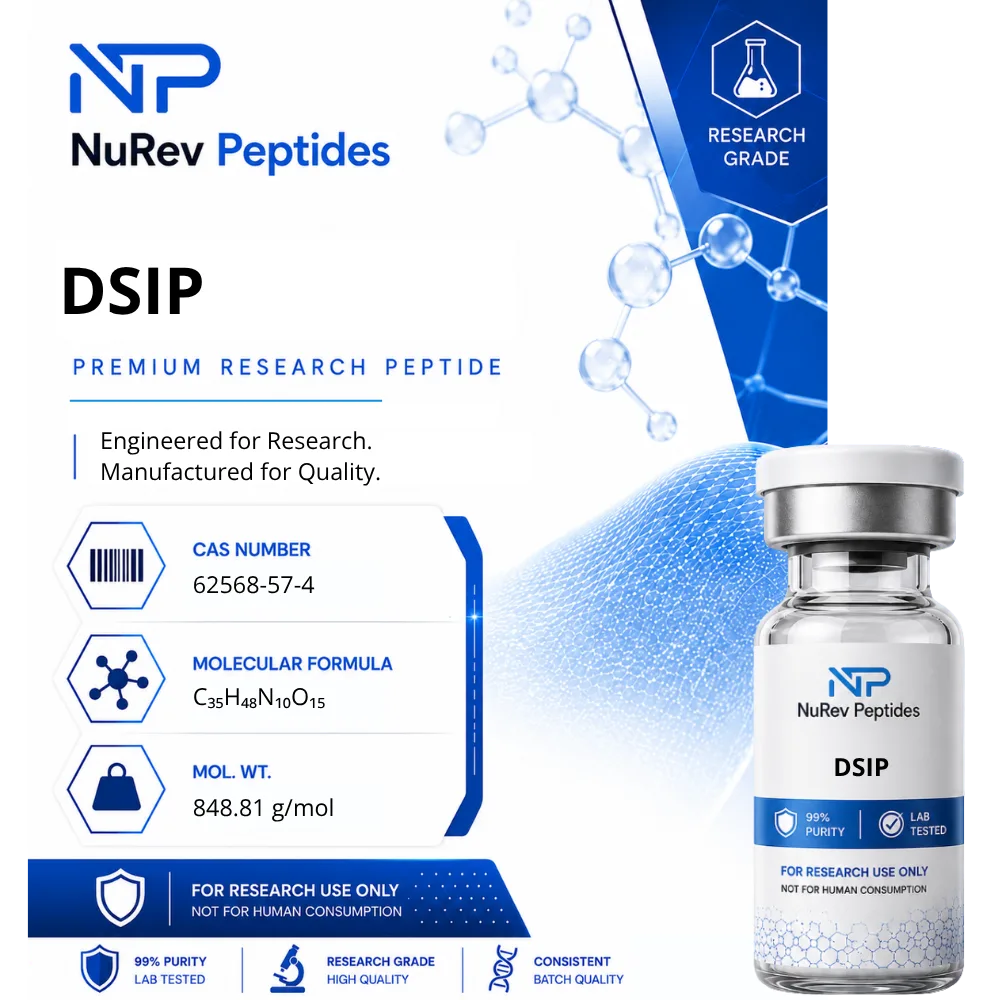
- Molecular formula: C35H48N10O15
- Molecular weight: approximately 848.8 g/mol
- Form supplied for research: lyophilized powder
Discovery and Background
DSIP was isolated in 1977 by a Swiss research group led by Schoenenberger and Monnier. The peptide was obtained from the cerebral venous blood of rabbits in which a sleep state had been experimentally induced, and it took its name from the increase in delta-wave (slow-wave) EEG activity reported when it was given to recipient animals.
DSIP-like immunoreactivity was later reported in the hypothalamus, pituitary, other brain regions and peripheral tissues, as well as in plasma and other body fluids.
Proposed Mechanisms
Unlike most neuropeptides, DSIP has no confirmed receptor and no identified precursor gene. Because of this, its mechanism is described in terms of observed associations and not a defined signaling pathway. The literature discusses:
- Sleep-related EEG activity: effects on slow-wave activity in some animal experiments
- Stress-axis signaling: interactions with corticotropin (ACTH) and glucocorticoid regulation
- Neurotransmitter systems: reported links with GABAergic and glutamatergic (NMDA) signaling
- Pituitary hormones: effects on luteinizing hormone and somatotropin release in certain models
- Oxidative stress: changes in antioxidant enzyme activity described in rodent studies
Areas of DSIP Research
Sleep architecture
Sleep was the original research focus. Results across studies have been inconsistent: some experiments reported changes in slow-wave sleep, while others found little or no effect. This inconsistency is one reason the peptide's physiological role is still debated, and some authors have questioned whether "sleep-inducing" is an accurate name.
Stress response
DSIP has been examined in animal models of stress, with attention to the hypothalamic-pituitary-adrenal axis and behavioral measures.
Nociception
Some preclinical work has investigated DSIP in pain-signaling models, including possible interactions with opioid pathways.
Circadian and endocrine rhythms
Researchers have also looked at whether DSIP levels vary across the day and how they relate to hormone rhythms.
Stability and Pharmacokinetic Questions
DSIP is degraded quickly by peptidases in vitro, with a half-life reported in the range of minutes in blood. This has prompted research into how the peptide might be protected in circulation, for example through binding to carrier proteins, and into more stable synthetic analogs. Studies have also reported that DSIP can cross the blood-brain barrier.
Key Published DSIP Peptide Studies
The DSIP peptide literature spans several decades. These papers are useful starting points:
- Characterization of a delta-electroencephalogram (-sleep)-inducing peptide (Schoenenberger and Monnier, Proceedings of the National Academy of Sciences, 1977). The original report describing the isolation, sequence and synthesis of the nonapeptide.
- Delta-sleep-inducing peptide (DSIP): a review (Graf and Kastin, Neuroscience and Biobehavioral Reviews, 1984). An early review of the first years of DSIP research, covering work beyond sleep.
- Delta sleep-inducing peptide (DSIP): a still unresolved riddle (Kovalzon and Strekalova, Journal of Neurochemistry, 2006). A later review that sets out the open questions, including the absence of an identified gene or receptor and the inconsistent sleep findings.
Reading the 1977 report next to the 2006 review shows how the field moved from an apparently simple sleep factor to a peptide whose function is still being argued over.
DSIP Compared With Other Research Peptides
DSIP is often grouped with other neuropeptides studied in laboratory settings, although they are structurally unrelated. Selank is a synthetic analog of the immune peptide tuftsin, and Epitalon is a synthetic tetrapeptide based on a pineal extract. DSIP differs from both in being an endogenous peptide that was isolated from blood before its function was understood.
What to Look for in Research-Grade DSIP
- A batch-specific Certificate of Analysis from an identified laboratory
- Reported purity by HPLC
- Identity confirmation by mass spectrometry
- A lot number that matches the vial
- Clear research-use-only labeling
Batch documentation for DSIP 10mg is available in the NuRev Peptides Certificate of Analysis library.
Storage and Handling
Because DSIP is readily degraded, material handling matters in experimental work. Lyophilized peptides are generally kept sealed, dry, protected from light and stored cold according to the laboratory's standard procedures.
Limitations of the Current Evidence
Much of the DSIP literature is several decades old, sample sizes were often small, and findings have not always been reproduced. With no confirmed receptor or gene, basic questions about its biology remain unanswered. DSIP is not an approved drug.
Research Use Only
This article is provided for educational and informational purposes only. Products supplied by NuRev Peptides are intended strictly for laboratory research use and are not intended for human or veterinary use.
Frequently asked questions
What is DSIP peptide?
DSIP (delta sleep-inducing peptide) is a nine-amino-acid neuropeptide first isolated in 1977. It is studied in laboratory research on sleep-related brain activity, stress signaling and endocrine regulation.
What does DSIP stand for?
DSIP stands for delta sleep-inducing peptide, named for the delta-wave EEG activity reported in the original animal experiments.
Is the DSIP receptor known?
No. Neither a specific receptor nor a precursor gene for DSIP has been conclusively identified, which is one reason its biological role is still debated.
Is DSIP approved for human use?
No. DSIP is a research compound. Material sold by NuRev Peptides is for laboratory research use only and is not for human or veterinary use.
Does DSIP come with a Certificate of Analysis?
NuRev Peptides provides batch-specific Certificates of Analysis for DSIP, available in the COA library and on the product page.